
Union County Criminal Docket Searches
One portal covers the local criminal index: the Union County Online Court Records System. It indexes both Circuit Court and General Sessions. Pick a court type. Set the case type to Criminal. Then search a full first and last name. A case number works even better, and the help files offer a tip. A reference like 99GS1-2023-CR-12345 should be entered as 12345 in the Case Number field.
- Choose Circuit Court or General Sessions and Criminal.
- Enter a full name, case year, or final number segment.
- Complete verification and submit the search.
- Check the court, year, and events on a possible match.
- Ask the Circuit Court Clerk for a current setting or copy.
Nothing came back? Switch the court choice and strip out any punctuation. An empty result never proves a Union County criminal case does not exist.
Union County Criminal Docket Choices
Each court level does different work. General Sessions takes lower-level criminal matters and the early stages of bigger cases. Circuit Court and Eighth Judicial District Criminal Court carry the higher trial path, including felonies. Juvenile and municipal files live with separate offices. So a name-only search may need both public form choices. Refine smartly. Combine search terms with Case Year. Results cap at 2,500 rows. The search engine allows quoted phrases and some typo tolerance. The result-page Filter, while handy, only hides visible rows. Save the exact criteria you used so a clerk follow-up goes smoothly. The public form promises neither full historical coverage nor a refresh schedule.
Criminal Dockets: What They Show
Think of a Union County criminal docket as an event index. It is not the whole clerk file. A short entry may point to an order you must request separately. For appearance duties, balances, or release questions, confirm directly with the court.
| Case number | The court identifier for the matter. |
|---|---|
| Charge | The filed offense or count, subject to change. |
| Setting | Arraignment, motion, status, plea, or trial event. |
| Plea | The response entered to a charge, when shown. |
| Disposition | A plea, dismissal, diversion, trial result, transfer, or remand. |
Copy the text, date, count, and court first. Then ask the clerk what the entry means.
Union County Criminal Docket Rhythm
Union County sits in Tennessee's Eighth Judicial District. Current district rules schedule Union criminal court roughly every five to seven weeks. A next-year calendar is issued around July. Two Fridays each month go to Recovery Court. Older local rules placed terms on the fourth Monday of January, May, and September. Check the current district rules first and confirm the date. The opening day of a court week is usually administrative and nonjury. Trial work tends to fill the later days. Dispositions, arraignments, and compliance matters crowd the early part of the week. Pretrial motions and bench trials land there too. No room label can predict when a single case gets called.
Criminal Case Stages on the Docket
Arraignment puts the charge and the plea on record. A not-guilty plea may bring an order that sets discovery, motion, plea, and trial deadlines. Motions are heard in set nonjury periods, and a negotiated result may require advance written notice.
Docket flow: Charge Filed › Arraignment › Pretrial › Plea or Trial › Disposition › Sentencing
A reset does not dismiss a charge. Diversion is not dismissal either. Read every result with its count and order in view. For the full name and number field details, see the Union County docket search instructions.
Union County Criminal Docket Filings
State AOC figures for fiscal year 2024-25 show 340 Union criminal counts filed and 321 disposed. Counts are not cases or people. The largest categories: 92 drug counts, 52 probation violations, 39 government-administration offenses, 34 burglary or theft counts, 30 assault counts, and 29 other motor-vehicle counts.
That report also lists 190 guilty pleas as charged and 101 dismissals or nolle prosequi entries, plus smaller groups. These numbers describe workload. They say nothing about any single Union County criminal docket.
Union County Criminal Docket Courts
Where does a criminal case actually live? General Sessions Criminal is the likely first stop for lower-level charges and preliminary events. Circuit Court/Criminal is the other local portal choice. The Eighth Judicial District governs felony trial work. Circuit Court Clerk Barbara Williams keeps both Circuit and General Sessions records at 901 Main Street, Suite 201, Maynardville, Tennessee 37807. The listed phone is 865-992-5493. Juvenile cases belong to Youth Services, while city ordinance and municipal traffic cases sit with city custodians. Appeals show up in the Tennessee Public Case History, which is not a statewide trial-court database.
Union County Criminal Docket Settings
Local criminal rules set trial days at 9:00 a.m., but no numeric call order is promised. Felonies get priority. Incarcerated defendants rank highest of all. So a general Criminal Court calendar entry cannot give you a precise call time.
- Arraignment
- The charge and plea stage.
- Pretrial motion
- A request heard before trial.
- Nolle prosequi
- A prosecutor's decision not to proceed on a charge.
- Capias
- Process that may issue after failure to appear.
A continuance needs court approval; an informal agreement between parties never moves a Union County criminal docket setting.
Access Rules for Criminal Dockets
Two rules control what the public can see. Tennessee Supreme Court Rule 34 governs access to court records, with exceptions for sealed, confidential, protected, or redacted material. The Tennessee Public Records Act covers inspection and copies for Tennessee citizens, subject to its own exceptions.
Key rules: Tenn. Code Ann. § 10-7-503 addresses inspection and copies. Section 10-7-505 supplies an access-dispute framework. Rule 34 recognizes court-specific restrictions.
Criminal files stay in clerk custody. You can examine them at the office when access is allowed. A docket event being visible does not make every attachment public. For an in-person, phone, or copy request, bring the court, the case number, the date, and the exact item.
Union County Criminal Docket Appeals
The official Tennessee appellate sample shows trial-court fields, appeal milestones, filings, history, roles, and disposition fields.
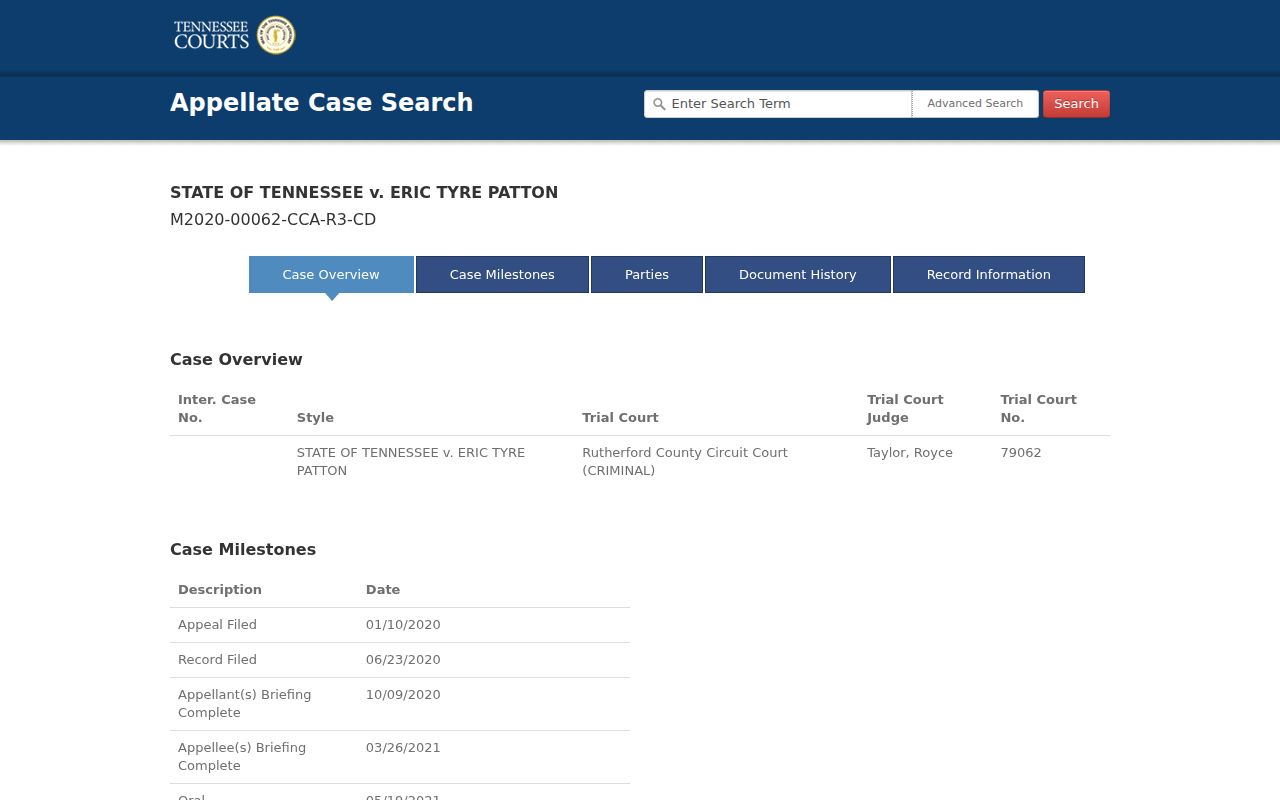
One caution about appeals. What an appellate record shows will not match what the Union trial index displays. Do not expect the same fields or PDF documents there. For the local file, go to the Circuit Court Clerk. Public Case History only becomes useful once an appeal has actually been filed.
Clerk staff can walk you through access, but they cannot give legal advice. A narrow request works best. Name a specific filing or a date range. Do not ask for every record tied to a person.
Union County Criminal Docket Fallbacks
The public index is one door into a Union County criminal docket, not the only one. Phone the Circuit Court Clerk. Or visit the courthouse counter for Circuit and General Sessions questions. Have your details ready. Know the court and the full case number if known. Bring the party name and an approximate filing or hearing year. Ask three things. Can the entry be inspected, and can you get a plain or certified copy? How must the copy charge be paid? Files stay in clerk custody, and no original leaves the office.
Keep a mailed request to one case. State the exact item sought, whether a disposition, order, or docket entry. Before it goes in the mail, confirm the method, cost, and accepted payment. There is no universal email or fax process for every record request. A published fax number does not mean every request type may be faxed. One quick phone call can prevent a mistake. It keeps your request from landing in the wrong office.
Match the office to the case. Juvenile Court and Youth Services handle protected juvenile matters. City ordinance and city traffic cases sit with municipal clerks. Tennessee Public Case History covers appeals. Federal cases run through the Eastern District of Tennessee and PACER. The County Clerk does not hold trial-court records. Picking the right office often beats a broad name search in a database that never covered that court.
A calendar check adds context, but it replaces nothing. The Union County Court Rooms calendar lists sessions. Criminal Court, Grand Jury, Recovery Court, General Sessions, and Circuit Court Status are examples. The calendar usually omits the party and case number. Lawyer, filing, and outcome are left out too. Compare the room or session label with the docket entry, then ask the clerk to confirm the date. Current Eighth Judicial District rules describe Union criminal court on a five-to-seven-week rhythm. Two Fridays per month are reserved for Recovery Court. Older local material names fourth-Monday terms in January, May, and September. Trust the current district calendar and direct clerk confirmation over both.
The type of setting matters too. Day one of a criminal court week is generally administrative and nonjury. The remaining days usually carry trials. Early term work can include dispositions, pretrial motions, bench trials, compliance matters, and arraignments. Felony trials get priority. Incarcerated defendants receive the highest priority of all. A 9:00 a.m. start promises no numeric call order. It does not promise an exact time for your case either. Copy the setting label exactly as written. Do not translate it into a trial date.
When you request the file itself, distinguish the docket from a particular pleading, order, minute, or disposition. Tennessee Supreme Court Rule 34 allows public access subject to sealing, confidentiality, redaction, and other lawful limits. So a visible docket event may point to a paper that is not publicly displayed. Ask whether office inspection is available. Then ask whether the copy you need is plain or certified. A Subscription Login on the public search does not mean a paid user can view restricted filings. The local system publishes no complete coverage or refresh guarantee.
If a case reaches a Tennessee appellate court, Public Case History becomes a second record layer. It can show the trial-court origin, appeal milestones, case history, roles, disposition, and qualifying PDF filings. Its prior-business-day update statement covers the appellate database only. The Union County Circuit Court Clerk still holds the local trial record. A federal criminal matter stays outside both systems. Look to the Eastern District of Tennessee and PACER.